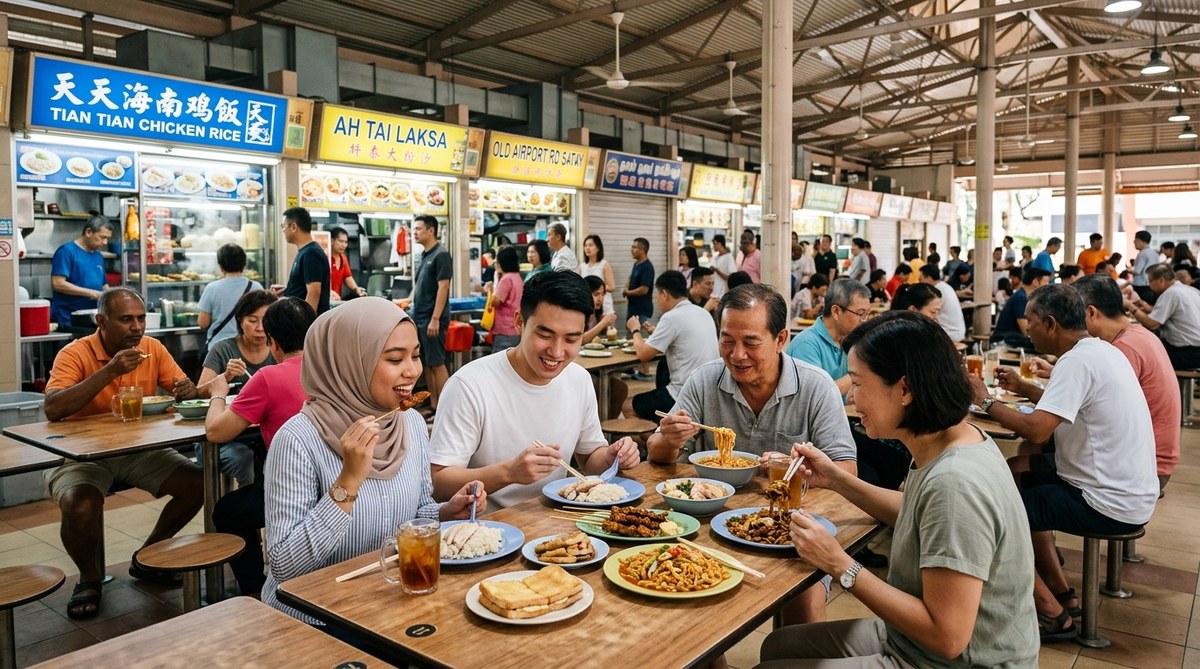
Planning a food trip to Singapore in 2026? You have probably seen the glossy lists of Michelin starred restaurants and flashy seafood promos along the river. But ask any Singaporean where they actually eat on a random Tuesday night, and the answer is rarely those places. Real local dining happens at hawker centres tucked inside housing estates, kopitiams that have been frying noodles for forty years, and small stalls where the queue of uncles and aunties tells you everything. This guide is for the traveller who wants to skip the tourist menus and eat where the locals do.
To eat like a local in Singapore in 2026, focus on heartland hawker centres and family run coffeeshops rather than famous hawker meccas. Look for stalls with long queues of older Singaporeans, order dishes like Hainanese chicken rice or wanton mee, and avoid places with menus in every language. Use Google Maps in Chinese or Malay to spot hidden gems. Always ask a taxi uncle for their favourite stall.
Why Tourists Often Miss the Real Food Scene
It is easy to fall into the trap of only visiting the same five hawker centres that appear on every travel blog. Maxwell Food Centre, Lau Pa Sat, and Newton are popular, but locals will tell you the quality has slipped in some of those famous stalls. Prices have crept up, and the crowds are huge.
Common tourist habits that lead to average meals:
- Trusting only Instagram famous stalls without checking if locals queue there.
- Sticking to central areas like Orchard Road and Marina Bay, where food is priced for visitors.
- Skipping the heartland neighbourhoods like Toa Payoh, Bedok, and Tampines.
- Ordering only what they recognise, missing out on regional specialities.
- Eating at restaurants with waiters and white tablecloths instead of plastic stools under a fan.
Locals prioritise flavour, value, and speed. A good plate of char kway teow at a kopitiam in a Housing Board estate costs around five dollars and tastes better than a $30 version at a tourist spot. The secret is knowing where to look.
The Best Hawker Centres for Authentic Local Meals
Not all hawker centres are equal. Skip the ones that feature in every listicle and head to these places that Singaporeans actually visit after work.
| Hawker Centre | Best Known For | Insider Tip |
|---|---|---|
| Old Airport Road Food Centre | Hokkien mee, satay, rojak | Go on a weekday around 11am to avoid the lunch rush. |
| Fengshan Food Centre (Bedok) | Wanton mee, carrot cake | Look for stall #01-08 for the wanton mee with char siew. |
| ABC Brickworks Market & Food Centre | Curry puffs, fish soup | The curry puff stall has been there for over 30 years. |
| Chomp Chomp Food Centre (Serangoon) | Hokkien prawn mee, sambal stingray | Arrive by 6pm to get a seat under the shelter. |
| Whampoa Drive Market & Food Centre | Teochew porridge, duck rice | Perfect for a late night meal after 10pm. |
Every one of these centres has at least one stall that has been operating since the 1980s. The owners pass down recipes to their children, and the taste stays constant. If you see a queue of mostly older Singaporeans in slippers holding umbrellas, join it.
How to Find Hidden Gems Like a Local
Finding the best food in Singapore does not require a secret app. Follow these steps and you will discover spots that rarely appear on English language blogs.
- Open Google Maps and search in Chinese or Malay. Try typing "好料" (good food) or "makan sedap" (delicious food). The results will show stalls populated by local reviews, not tourist ratings.
- Look for queues during off peak hours. A stall with a line at 3pm is serving something worth standing for. Avoid stalls with long lines of young tourists holding phones.
- Check the menu language. If the menu is only in Chinese, Malay, or Tamil, you have found a local spot. If they offer English with pictures, it is designed for visitors.
- Ask a taxi uncle before you get out. Taxi drivers eat everywhere. They know which nasi lemak is worth the detour.
- Eat at a kopitiam inside a Housing Block. Many older estates have a single coffee shop on the ground floor with one or two stalls. The food there is priced for residents.
Once you try this method, you will start finding places that feel like discoveries. For a deeper look at specific stalls, check out our guide to hidden food gems in Singapore.
Three Dishes You Must Try and Where to Eat Them
You cannot visit Singapore without eating these three dishes. But the versions served at tourist centres are not always the best.
Hainanese Chicken Rice
The best chicken rice comes from stalls that steam the bird until the skin is silky and the meat is tender. The rice is cooked in chicken fat and pandan leaf. Skip the popular chain and head to a stall like Tian Tian in Maxwell? Actually, many locals now prefer Boon Tong Kee at Whampoa or the stall at Hainanese Delicacy in Tiong Bahru Market. Look for one that offers both roasted and steamed options.
Laksa
There are two main styles: the rich coconut based Katong laksa and the sour spicy Penang assam laksa. For Katong laksa, locals go to Sungei Road Laksa near Little India. Their broth is thick, fragrant, and filled with small pieces of cockles. Do not let the short queue fool you; they serve it in small bowls so you can order two or three.
Chilli Crab
Many restaurants along the river charge $60 for a plate. Locals go to Mellben Seafood in Ang Mo Kio or Sin Huat Eating House in Geylang. These places are casual, noisy, and perfect for sharing. The sauce is sweet, spicy, and meant to be wiped up with mantou (fried buns).
"The best advice I give to friends visiting Singapore is to ignore the first three Google results for each dish. The fourth or fifth result is often a small stall run by a family that has been perfecting one recipe for decades. That is where you will find the real taste." — Mr. Tan, owner of a 40 year old wanton mee stall in Toa Payoh
Common Mistakes Tourists Make and How to Avoid Them
| Mistake | Why It Happens | What to Do Instead |
|---|---|---|
| Eating at the same hawker centre every meal | Sticking to the nearest place to hotel | Take the MRT to a different heartland station each day. |
| Ordering only what you recognise | Fear of trying unfamiliar dishes | Pick one new dish per meal. Ask the stall owner what is popular. |
| Paying with credit cards | Assuming all stalls accept cards | Carry at least $20 in cash. Many local stalls are cash only. |
| Visiting during peak meal hours | Wanting to see the hustle | Go at 10am or 3pm for shorter queues and fresher food. |
| Not asking for "less oil" or "less sweet" | Not knowing you can customise | Local stalls are happy to adjust seasoning. Just ask. |
Where to Go Beyond Hawker Centres
Hawker centres are the backbone, but locals also eat at coffeeshops (kopitiams) and food courts inside shopping malls. The food court version is often a step down, but some malls have excellent stalls. For example, the basement food court at Plaza Singapura has a Hokkien mee stall that draws office workers daily.
Another option is zi char (cook fry) stalls. These are open air kitchens attached to coffee shops. You order dishes like sambal kangkong, sweet and sour pork, or steamed fish. The best ones are in older neighbourhoods. One hidden gem is Keng Eng Kee Seafood in Alexandra Village. It is not on any tourist map, but the salt egg pork ribs are legendary.
If you want to explore beyond the usual spots, our guide to Singapore's best food trails for authentic local flavours will point you to more neighbourhoods worth visiting.
Also remember that Singapore has incredible Peranakan (Nyonya) cuisine. Head to Candlenut for a refined version, or try the more casual Catherine's in Joo Chiat for ayam buah keluak and assam fish.
Final Tips for Your 2026 Food Adventure
Singapore's food scene changes slowly, but a few things stay constant. The best meals are still served on plastic plates under fluorescent lights. The most memorable flavours come from stalls where cash is the only accepted payment. And the people who know the best spots are usually the ones eating there.
As you plan your trip, keep a list of heartland hawker centres and kopitiams. Use the queuing method. Do not be afraid to order in Mandarin or Malay even if you only know a few words; stall owners appreciate the effort.
And finally, give yourself permission to eat the same thing twice. If you find a stall that serves perfect char kway teow, go back the next day. That is what locals do.
For a complete list of must try local dishes and the best places to find them, see our ultimate guide to authentic local dishes in Singapore. And if you have time, check out where to eat in Singapore like a local in 2026 for a curated walking itinerary.
Happy eating. Your next great meal is just a queue away.