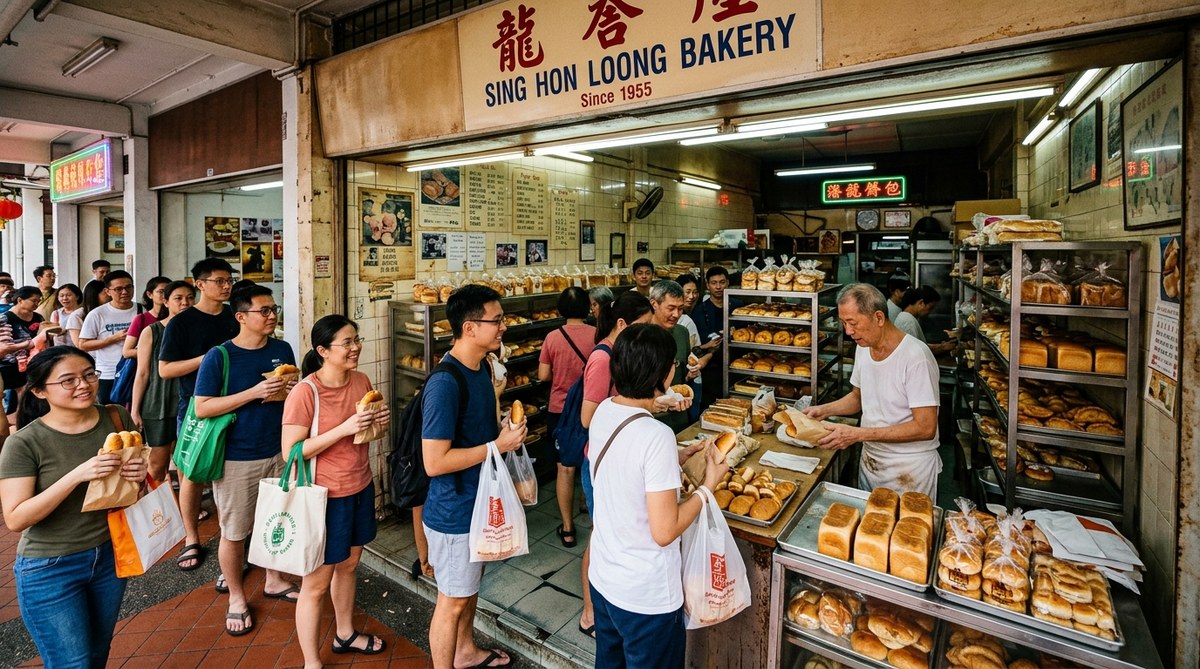
The queue stretches past the coffee shop, out into the covered walkway, and curls around the corner. It is 9 am on a Tuesday, and the crowd at this old-school bakery in Toa Payoh is a mix of retirees in slippers, office workers in smart casual, and young parents with toddlers in strollers. They are all waiting for the same thing: a tray of freshly baked bread, still warm, that smells like the Singapore of the 1980s. In a city obsessed with the newest cafe opening and the latest viral dessert, these traditional bakeries are not just surviving. They are thriving. Here is why these old-school bakeries in Singapore are still packed in 2026, and why you should join the queue.
Old-school bakeries in Singapore remain packed in 2026 because they offer something modern cafes cannot replicate: genuine nostalgia, affordable prices, and recipes that have been passed down for generations. The queues are driven by a return to simple, honest baking and a craving for the flavours of childhood. Visiting these bakeries is a taste of living heritage, not just a meal.
The Secret Behind the Long Queues
Walk past a hipster bakery selling sourdough at eight dollars a loaf, and you might see a few customers. Walk past Swee Heng Bakery at 7 am, and you will see a line. Why? The answer is not complicated. These bakeries sell food that tastes like home. Their recipes have not changed in forty years. Their prices have barely changed either. A curry puff for one dollar and twenty cents. A loaf of white bread for two dollars. In 2026, that kind of value is rare.
But price alone does not explain the crowds. There is an emotional pull. Singaporeans are nostalgic people. We grew up eating these buns. We remember our grandparents buying them from the same shop. When we bite into a soft, sweet bun from a traditional bakery, we are tasting our own history. That is something a cronut can never replace.
What Makes a Bakery “Old-School” in Singapore?
Not every bakery that has been around for a while counts as old-school. The term means something specific here. It refers to bakeries that started in the 1960s, 1970s, or 1980s. They use traditional methods. They bake in deck ovens, not convection ovens. They make their own fillings from scratch. They serve classic items like:
- Hainanese curry puffs with a flaky, almost pastry-like crust
- Kaya buns with homemade coconut jam and a slab of cold butter
- Kopi buns that are glazed with coffee and sugar before baking
- Swiss rolls with light, airy sponge and real fruit jam
- Muffins that are dense, not fluffy, and studded with dried fruit
These items are not fancy. They are reliable. And that reliability is exactly why people keep coming back.
The Top 10 Old-School Bakeries to Visit in 2026
Here is our curated list of bakeries that still draw crowds in 2026. Each one has a story, a specialty, and a loyal following.
1. Swee Heng Bakery (Toa Payoh)
The granddaddy of them all. Swee Heng has been operating since the 1970s. Their signature is the traditional curry puff. The filling is a thick, savoury potato and chicken mix with a hint of spice. The pastry is buttery and shatters when you bite it. Expect a wait of at least fifteen minutes during peak hours.
2. Roti Kaya Bakery (Tiong Bahru)
Tucked inside a housing estate, this tiny shop is famous for one thing: the kaya bun. They make their own kaya on site. The coconut jam is thick, fragrant, and not too sweet. They slather it on a soft bun with a thick slice of butter. It is simple perfection.
3. Beng Swee Bakery (Geylang)
A Bakery that has been around since the 1960s. Beng Swee is known for its old-school Swiss rolls and pineapple tarts. During Chinese New Year, the queue for their tarts stretches down the block. In 2026, they still use the same recipe from the founder’s grandmother.
4. Kimly Bakery (Joo Chiat)
Kimly is a Hainanese bakery. That means they specialise in Western-style baked goods adapted for local tastes. Their signature is the chicken pie. It is a hand-sized pie filled with a creamy chicken and mushroom sauce. It is comfort food at its best.
5. Lai Kee Bakery (Chinatown)
Located on Smith Street, Lai Kee is famous for its mooncakes. But their everyday star is the traditional sponge cake. It is light, fluffy, and slightly sweet. They also make a mean pandan cake that stays moist for days.
6. Tong Heng Bakery (Jalan Besar)
Tong Heng is a Hakka-style bakery. They are known for their traditional biscuits, especially the salted egg yolk biscuit. It is a flaky pastry filled with a savoury, runny yolk. It is an acquired taste, but locals love it.
7. Ah Chew Bakery (Katong)
Ah Chew is a relative newcomer, having started in the 1990s. But their methods are pure old-school. They bake everything in a wood-fired oven. Their signature is the charcoal bun, a black bun made with activated charcoal powder. It is a modern twist on a classic.
8. Sin Huat Bakery (MacPherson)
Sin Huat is a hidden gem. They are not on social media. They do not have a website. They just bake. Their specialty is the traditional butter cake. It is dense, rich, and tastes like the butter cakes your grandmother used to make. They sell out by noon every day.
9. Guan Lee Bakery (Beach Road)
Guan Lee is a Malay-style bakery. They specialise in traditional Malay cakes like kuih lapis and ondeh ondeh. But they also make a mean roti jala, a lacy pancake that is perfect with curry. The queue here is always a mix of Malay and Chinese customers.
10. Tian Tian Bakery (Ang Mo Kio)
Tian Tian is famous for their kopi buns. The bun is glazed with a mixture of coffee and sugar before baking. The result is a crunchy, caramelised crust with a soft, fluffy interior. It pairs perfectly with a cup of traditional kopi.
How to Make the Most of Your Visit
To avoid disappointment, follow these steps:
- Go early. Most bakeries open by 6 am or 7 am. The best items sell out by 10 am. If you want a curry puff from Swee Heng, be there before 8 am.
- Bring cash. Many old-school bakeries do not accept cards or PayNow. Some have started to accept digital payments, but cash is still king.
- Order in bulk. If you see a long queue, buy enough for a few days. These buns freeze well. Just pop them in the toaster to revive them.
- Ask the aunties. The staff at these bakeries have been working there for decades. They know which batch is freshest. Ask them what they recommend.
- Be patient. The queue is part of the experience. Chat with the people around you. You might learn a thing or two.
Common Mistakes Tourists Make
| Mistake | Why It Hurts | How to Fix It |
|---|---|---|
| Going at lunchtime | Items are sold out or stale | Go before 9 am |
| Expecting air conditioning | Most bakeries are warm | Dress lightly and bring a fan |
| Ordering one of everything | You will waste food | Start with two or three items |
| Asking for substitutions | Recipes are fixed | Accept the original version |
| Taking photos without buying | Staff may get annoyed | Buy something first |
“The secret to a good traditional bakery is patience. You cannot rush the dough. You cannot rush the proofing. And you cannot rush the queue.” Mr. Tan, owner of Swee Heng Bakery, 2026.
Why These Bakeries Are More Popular Than Ever
You might think that in 2026, with all the fancy bakeries and online delivery, these old shops would fade away. The opposite is true. Several trends are driving people back to old-school bakeries.
First, there is the cost of living. A loaf of bread from a traditional bakery costs less than three dollars. A single pastry from a cafe can cost six dollars. For families, the choice is clear.
Second, there is a growing interest in heritage food. Young Singaporeans are rediscovering traditional flavours. They want to eat what their parents and grandparents ate. Social media has helped. A video of a kaya bun being made can get millions of views.
Third, these bakeries have adapted without losing their soul. Many now offer online ordering. Some have started delivery. But they have not changed their recipes. They have not raised their prices too much. They have found a balance between tradition and convenience.
If you want to understand Singapore’s food culture, you need to visit these bakeries. They are not just places to buy bread. They are community hubs. They are living museums. They are proof that some things get better with age.
For more hidden food spots, check out our guide to discovering the top hidden food gems in Singapore. And if you want to plan a full day of eating, our ultimate guide to authentic local dishes in Singapore will help you build the perfect itinerary.
The Future of Old-School Bakeries in Singapore
In 2026, the outlook is positive. Many of these bakeries are now run by the second or third generation. They are investing in new equipment. They are training young bakers. They are opening new branches. But they are careful not to grow too fast.
The challenge is rising rents. Many bakeries are in prime locations. As the area gentrifies, the rent goes up. Some have had to move. Others have closed. But the ones that survive are the ones with the strongest community ties.
If you want to support these bakeries, the best thing you can do is visit them. Bring your family. Bring your friends. Post about them on social media. The more people know about them, the more likely they are to survive.
A Final Word on the Magic of Old-School Bakeries
There is a reason why these bakeries are still packed in 2026. It is not just the food. It is the feeling. It is the smell of fresh bread hitting you as you walk through the door. It is the sight of the aunties working the dough with their bare hands. It is the taste of a bun that tastes exactly the same as it did when you were a child.
In a world that changes too fast, these bakeries are anchors. They remind us of who we are and where we came from. So the next time you see a long queue outside a shophouse, do not walk past. Join it. You will be glad you did.