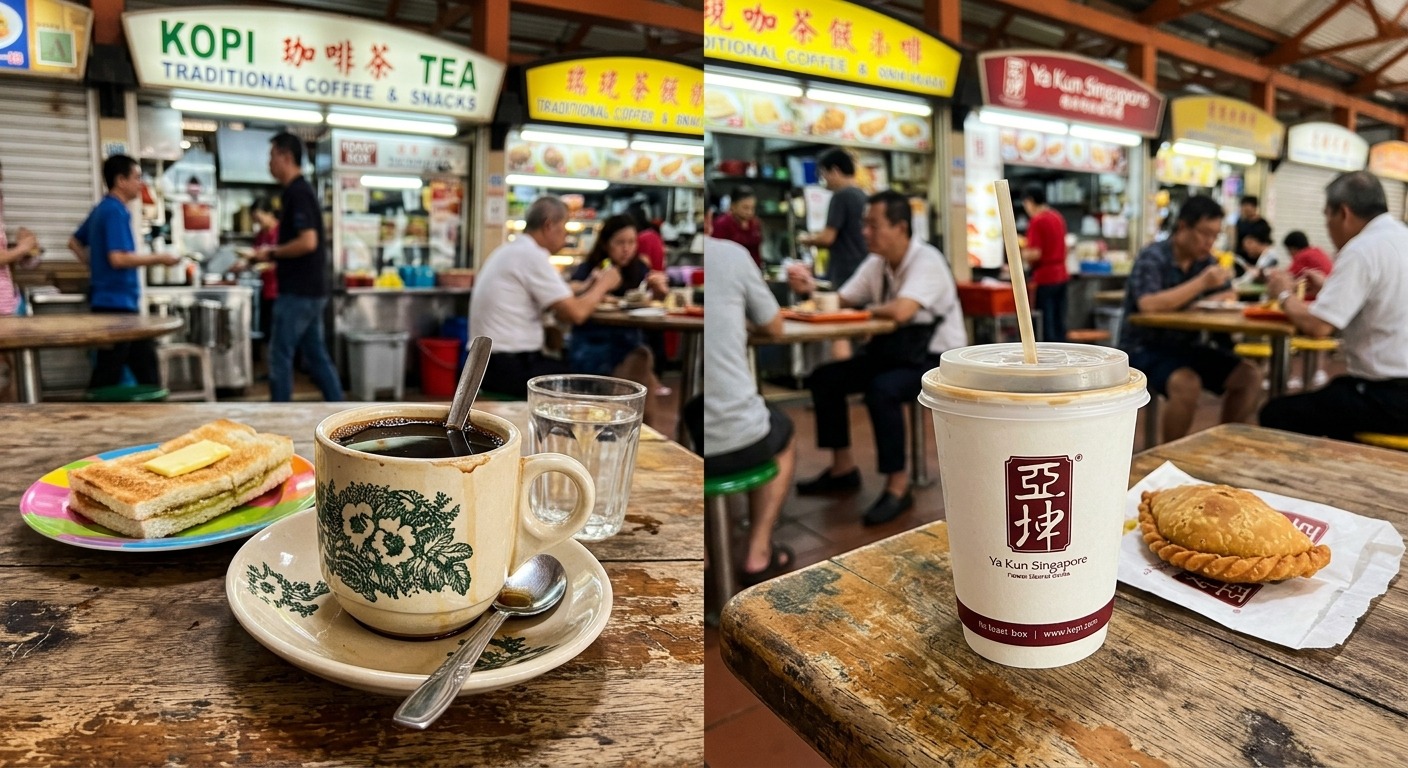
The ceiling fan has been going since five in the morning. A wet cloth swipes the marble-top table, a glass appears, and thirty seconds later you are holding a kopi that costs one dollar. The coffee is dark and rich, threaded with condensed milk, brewed through a cloth sock strainer that looks ancient and works beautifully. Outside, the hawker centre is filling up. Uncles in singlets are already halfway through their second cup. This is not a romantic throwback. This is just Tuesday in Singapore.
Your Kopi at a Glance
- Traditional kopitiam kopi starts at around $1 and is one of the most affordable hot drinks you will find anywhere in Singapore.
- Learning a few ordering terms like kopi-o kosong and kopi-c lets you customise your cup without paying anything extra.
- Budget chain cafés fill the gap between hawker stalls and specialty coffee, with decent options often priced under $4.
Where Kopitiam Coffee Fits Into Everyday Life
Singapore’s kopitiam coffee has roots that stretch back to the early twentieth century, when Hainanese immigrants set up coffee shops across the island and developed a brewing style that became distinctly local. The beans are roasted with sugar and butter, which gives the brew its signature dark, slightly caramelised body. It is nothing like filter coffee and nothing like a flat white. It is entirely its own thing.
The hawker centre is where most people encounter it today. You will find a coffee stall in almost every hawker centre across the island, usually run by someone who has been doing this for decades. The setup is minimal: a cloth sock filter, giant kettles, a row of cups, and jars of condensed milk and evaporated milk. The process is fast. The result is consistent.
Singapore’s hawker culture, including the coffee stalls that anchor it, earned its intangible cultural heritage recognition from UNESCO in 2020, a distinction that reflects how deeply embedded these everyday rituals are in the national identity. That $1 cup carries more history than most people think about at seven in the morning.
Prices across neighbourhood kopitiam stalls remain impressively stable. Most hot kopi sits between $1 and $1.50. Iced versions run a little higher, usually $1.20 to $1.80. Even in more central locations, you are rarely paying above $2 for a traditional cup. That consistency is part of what makes kopitiam coffee such a reliable fixture in the daily routine.
Cracking the Kopi Order Code
The kopitiam menu board is not always a board. Sometimes it is a laminated card, sometimes a handwritten sign, sometimes nothing at all because the regulars already know what they want. If you are new to the system, a handful of terms carry you a long way.
Kopi is the base: coffee brewed with condensed milk, slightly sweet and full-bodied. Kopi-o is black coffee with a little sugar. Kopi-o kosong is black coffee with no sugar whatsoever. Kopi-c uses evaporated milk instead of condensed milk, giving it a lighter and less sweet finish. Add “gao” to any order for a stronger brew, or “poh” if you prefer it diluted. “Siu dai” means less sweet, and you can combine these modifiers freely, so a kopi-c gao siu dai is a strong coffee with evaporated milk and less sugar. The system is more flexible than it first appears.
Iced versions are equally popular, especially from midday onwards. Kopi peng is iced coffee with condensed milk. Kopi-o peng goes without the milk. A lot of regulars shift to iced versions automatically once the temperature climbs past a certain point, which in Singapore is basically all the time.
A Reference Guide to Kopi Ordering Terms
| Order | What You Get |
|---|---|
| Kopi | Coffee with condensed milk and sugar |
| Kopi-o | Black coffee with sugar, no milk |
| Kopi-o kosong | Black coffee with no sugar and no milk |
| Kopi-c | Coffee with evaporated milk, lighter and less sweet |
| Kopi gao | Extra strong coffee, more concentrated |
| Kopi poh | Lighter brew, more diluted |
| Kopi siu dai | Coffee with less sugar than the default |
| Kopi peng | Iced coffee with condensed milk |
Chain Cafés Have Earned Their Place in the Routine
Plenty of Singaporeans who grew up on kopitiam coffee also have a Ya Kun loyalty card. The two are not in conflict. They serve different moments in the day, and most people drift between them without giving it much thought.
Chain cafés in Singapore have gotten much better at offering affordable options without requiring you to commit to a $7 specialty pour-over. Ya Kun Kaya Toast and Toast Box are technically chains, but they keep the traditional format, serving local-style coffee alongside kaya toast sets at prices that hover around $3 to $5 for a full breakfast combo. The coffee is recognisably close to kopitiam style, the environment is air-conditioned, and the experience is reliable enough to build a habit around.
For readers who want to compare prices across multiple brands before deciding where to spend their daily coffee budget, a survey of cheapest chain coffee options across the market is a genuinely useful reference, because the price gap between chains can be surprising for drinks that taste fairly similar.
McDonald’s McCafé also deserves a mention here, and it tends to get overlooked. A basic latte or Americano runs under $3 at most outlets, the hours are generous, and the consistency is reliable when you need caffeine fast and cannot find a kopitiam nearby. It is not a destination. It is a utility, and it does the job well.
The broader competition in the sub-$4 coffee space has intensified in recent years, with chains targeting the daily commuter crowd rather than the weekend café visitor. That competition is good news for anyone watching their spend. Options are wider and prices have stayed reasonable as a result.
Reading the Room at a Kopitiam Stall
There is an unspoken rhythm at a busy kopitiam coffee stall, and picking it up makes the whole experience smoother. You do not hover and wait to be noticed. You approach, you state your order clearly and fast, and you step aside. The uncle or auntie behind the counter has done this more times than either of you can count. They do not need a moment to process your request.
Payment is usually cash, though many stalls now accept PayNow or have a QR code taped somewhere on the counter. If you are sitting at a table, some stalls will deliver to you. Others expect you to collect at the counter. Watching what the people around you are doing and following their lead is the fastest way to get the process right.
The plastic bag kopi is also worth knowing about, especially if you are taking your drink away. Coffee in a tied plastic bag with a straw poking through the top is completely normal here. It looks alarming the first time you encounter it. After that, it just looks like breakfast on the go.
Keeping Your Daily Coffee Spend Under Control
If you are tracking your daily expenses, the kopitiam model is almost impossible to beat as a starting point. A morning kopi grabbed on the way to the MRT puts your first cup of the day at $1 to $1.50. That is the practical floor for a freshly made hot drink in Singapore, and nothing is going to undercut it significantly.
Adding a chain café stop for a second cup later in the day, say a mid-morning coffee at a Toast Box or McCafé near your office, brings the total to somewhere around $3 to $5 for two coffees. Two good cups, two different experiences, total daily spend that stays well below what a single specialty café drink would cost.
For those on a genuinely tight budget, staying within the hawker centre for both cups is a completely viable approach. A gao kopi in the morning and a kopi peng in the afternoon is a full caffeine day for under $3. That formula has worked for Singaporeans across multiple generations, and there is no reason it stops working now.
Two Cups, One City: The Real Singapore Coffee Day
The actual Singapore coffee routine is not a debate between heritage and convenience. Most people are not choosing sides. They are just moving through the day and picking up coffee wherever it makes sense at the time. Kopitiam in the morning because it is fast, cheap, and exactly what you need before eight. Chain café mid-afternoon because you need a reason to leave your desk, the air-conditioning at the nearby kopitiam is broken, or the kopi peng stall ran out of ice by two o’clock.
Neither option is a compromise. They are both legitimate parts of a coffee culture that has quietly stayed affordable while the rest of the city got more expensive. Singapore gives you $1 coffee that is genuinely good, a vocabulary for customising it to your exact preference, and a network of chain cafés with decent options when you want something slightly different. That is a reasonable deal by any measure, and it is one worth taking advantage of every single morning when the fan starts turning and the first kopi of the day arrives at the table.