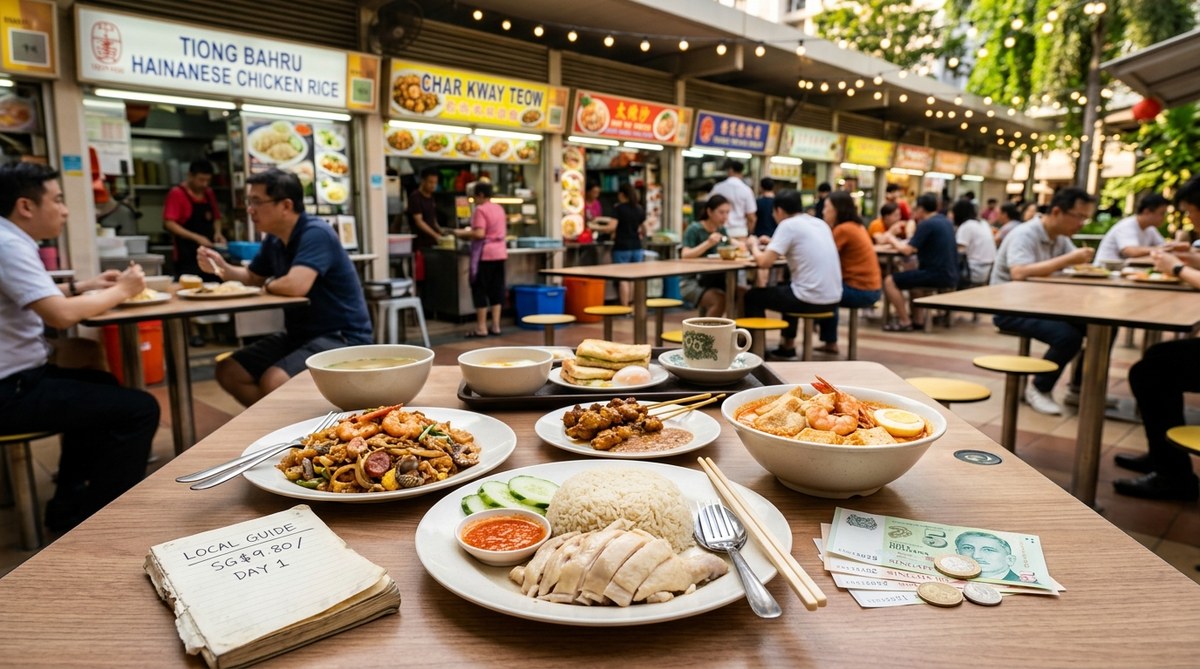
You walk into a hawker centre, scan the menu boards, and feel a familiar pinch. A plate of chicken rice is now $5. A bowl of laksa hits $6.50. A kopi and a kaya toast set you back nearly $4. Before you know it, you have spent more than $10 on just two meals. The question hanging in the humid air is simple: can you still eat well in Singapore on $10 a day?
We decided to put it to the test. Not with a theoretical budget, but with real meals bought across the island in 2026. We wanted to know if the old mantra of “Singapore is a food paradise for the budget traveller” still holds true. The answer is yes, but the strategy has changed. You cannot just wander into any food court and hope for the best. You need a plan.
Eating in Singapore on $10 a day is still possible in 2026, but it demands smart choices. Focus on hawker centres, skip drinks, share dishes, and target stalls with heavy subsidies. The golden rules are simple: breakfast under $3, lunch under $4, and dinner under $4. Yes, you will have to skip the Starbucks run, but you will eat real, flavourful food.
Why $10 Still Works If You Know Where to Look
The biggest misconception about eating in Singapore on $10 a day is that you have to survive on plain rice and instant noodles. That is simply not true. The hawker centre ecosystem, supported by government subsidies and high volume, keeps prices remarkably low for certain staples.
A plate of economic rice (mixed vegetable rice) at a heartland coffeeshop can cost as little as $3. A classic chicken rice from a stall like the ones at Chinatown Complex or Maxwell Food Centre hovers around $4. A roti prata with a small curry at a neighbourhood kopitiam costs about $1.50. The key is to avoid the “tourist belt” hawker centres like Lau Pa Sat during peak hours. Instead, head to places like Old Airport Road Food Centre, Zion Road, or the humble coffeeshops in Ang Mo Kio or Toa Payoh.
We mapped out a realistic day of eating in Singapore on $10 a day. Here is how it breaks down.
The $10 Meal Plan: A Real Day of Eating
We followed this plan for a week. It was not luxurious, but it was filling and delicious.
| Meal | Dish | Estimated Cost | Location Tip |
|---|---|---|---|
| Breakfast | Two kosong (plain) roti prata + one teh tarik | $2.50 | Any heartland kopitiam |
| Lunch | One plate of chicken rice (white meat, no skin) | $4.00 | Maxwell Food Centre |
| Dinner | One portion of bee hoon with three vegetables | $3.50 | Old Airport Road |
| Total | Three meals | $10.00 |
This menu works because it hits the sweet spot of affordability and nutrition. The prata gives you carbs and a little fat. The chicken rice provides protein. The bee hoon and vegetables add fibre and vitamins. You are not eating like a king, but you are eating like a local who knows where to go.
5 Practical Steps to Stretch Your $10
If you want to master eating in Singapore on $10 a day, follow these steps. They are not complicated, but they require a little discipline.
-
Eat breakfast at a kopitiam, not a cafe. A slice of kaya toast and two soft-boiled eggs with a cup of kopi will cost you about $3.50. That is a third of your budget gone before 9am. Instead, order roti prata kosong. It is cheaper and just as filling. Many stalls also sell a simple “breakfast set” of two prata and a drink for under $3.
-
Order your lunch before 11:30am. Most hawker stalls that serve economic rice or noodle soups offer a “early bird” portion. It is slightly smaller, but the price can drop by $1 to $2. If you eat at 11am, a $4 plate of bee hoon might cost you $3. The same portion at 12:30pm will be the full price.
-
Share a main dish. If you are eating with a friend, order one larger dish like a fish head curry or a claypot rice. Split the cost. You get more variety and the per-person cost drops below $5. This is a classic Singaporean move.
-
Drink tap water or plain water. A can of soft drink at a hawker centre costs $1.50. A bottle of sugarcane juice costs $2. A kopi costs $1.80. If you drink three beverages a day, you have just spent $5.40. That is half your budget on liquid. Drink plain water. It is free, or you can bring a refillable bottle.
-
Target “value” stalls. Look for stalls that advertise “economic” or “budget” meals. Many coffee shops have a dedicated stall that sells two vegetables and rice for $2.50. These stalls exist to serve construction workers and office cleaners. They are not fancy, but they are filling and cheap.
Common Mistakes That Will Blow Your Budget
Even experienced locals fall into these traps. Avoid them if you want to succeed at eating in Singapore on $10 a day.
-
Buying drinks at every meal. As mentioned, this is the biggest budget killer. A single teh tarik at lunch and a sugarcane juice at dinner can cost $3.50. That is a full meal’s worth of money.
-
Ordering “mala” or “soup” by weight. Mala hotpot and soup stalls charge by the 100g. It is very easy to grab a few ingredients and end up with a $7 bowl. Stick to fixed-price stalls.
-
Eating at “atas” (upmarket) hawker centres. The new “hawker centres” in the CBD or at places like Paya Lebar Quarter are designed for office workers with deeper pockets. A plate of nasi lemak there can cost $6.50. The same dish at a heartland stall costs $3.50.
-
Ordering “special” or “large” portions. The standard portion at most hawker stalls is already generous. Paying extra for a “large” or “special” portion adds $1 to $2 for very little extra food.
“The secret to eating cheaply in Singapore is to treat hawker food as fuel, not as a dining experience. You do not need the ‘special’ laksa with prawns. The regular one is just as good and costs half the price.”
* Local food blogger, quoted in a 2026 community survey on food affordability.
Where to Find the Best $3 Meals in 2026
Not all hawker centres are created equal. Some have a higher concentration of budget-friendly stalls. Here are three places where eating in Singapore on $10 a day feels effortless.
Old Airport Road Food Centre. This is a classic. The queues can be long, but the prices are still reasonable. Look for the stall that sells “Mee Rebus” for $3.50. It is a hearty noodle soup that will keep you full for hours.
Zion Road Food Centre. Located near the river, this centre is popular with both locals and tourists. But the back row of stalls, the ones that serve Indian and Malay food, still offer $3.50 nasi lemak and $2.50 prata. Avoid the front stalls that cater to the river crowd.
Chinatown Complex Food Centre. The sheer size of this place means competition keeps prices low. You can find a $3.50 plate of fried kuay teow and a $2.50 bowl of fishball noodles. It is a warren of alleys, so walk around before you commit.
For a more curated list of spots, check out our guide to discover the top hidden food gems in Singapore you must try. It includes stalls that are off the beaten path and often cheaper.
The $10 Challenge: What You Give Up
Let us be honest. Eating in Singapore on $10 a day means making trade offs. You give up:
- Variety. You will eat a lot of chicken rice, prata, and economic rice. That is fine for a few days, but it gets repetitive.
- Fresh juice and coffee. You will mostly drink water. That is healthier, but it is not as satisfying.
- Dinner out with friends. If your friends want to go to a tze char place or a restaurant, you will have to sit out or order very selectively.
- Snacks. No afternoon curry puff. No late night ice kacang. The $10 budget is for three meals only.
If you are a tourist on a tight budget, this is a viable strategy for a few days. If you are a local trying to save money, you can sustain it for a week or two, but it is not a long term solution for a balanced diet.
How to Navigate Hawker Centres Like a Pro
If you are new to this, the hawker centre can be intimidating. But getting the best value is a skill you can learn. Our guide on how to navigate Singapore’s hawker centres like a pro in 2026 covers everything from finding the cheapest stalls to knowing when to queue.
The short version is this: look for the stall with the longest queue of elderly locals. They know where the value is. Do not queue at the stall with the flashy sign and the Instagram-friendly plating. That stall is for tourists.
The Verdict on Eating in Singapore on $10 a Day
After a full week of testing, here is our honest verdict. Eating in Singapore on $10 a day is possible, but it is not comfortable. You will be full. You will eat real food. But you will feel the constraints. You cannot be spontaneous. You cannot have a kopi with a friend without thinking about the cost.
For a tourist passing through for a weekend, it is a fantastic way to experience local food without breaking the bank. For an expat trying to save money in their first month, it is a useful challenge to reset your spending habits. For a local on a tight budget, it is a survival skill.
The system works because of the hawker centre network. But it works only if you are disciplined. One mistake, like buying a $2.50 sugarcane juice, and your budget is blown.
Your Next Step: Try the 3 Day Challenge
Do not just take our word for it. Try eating in Singapore on $10 a day for three days. Use the meal plan above. Stick to the rules. See how it feels. You might find that you save more than you expected. You might also find that you miss the freedom of ordering whatever you want.
If you want to go deeper into the local food culture, read our ultimate guide to authentic local dishes in Singapore. It will help you identify the dishes that give you the most bang for your buck.
The hawker centre is a national treasure. It is one of the few places left where a $3 meal can still taste like a million bucks. Treat it with respect. Learn its rhythms. And you will never go hungry in Singapore, even on $10 a day.